The rule of three for reuse
The “rule of three” for reuse is a concept that emerged quite organically during a discussion about the scales of reuse. It is a very simple way of understanding that issues related to the reuse of materials arise very differently depending on the context.
The categories presented here should be understood as an expression of orders of magnitude. The choice of the number three is purely arbitrary, and somewhat aesthetic. Although this rule seems to hold up rather well in practice, we'll leave it to the reader to judge for themselves.
3 to 30 m²
This scale applies to small projects, sometimes falling into the realm of micro-architecture. Depending on the country, this scale does not necessarily require the involvement of an architect. Projects of this scale include apartment renovations, or the construction of extensions or tiny houses.
At this scale, there is a certain closeness between the roles of the designer, the user, and the builder. In some projects, a single person may even take on all three roles at once. This makes discussions more fluid and less formal. It is a scale where agreements can be verbal and based on interpersonal trust.
Since the quantities of materials involved are very modest, most professional suppliers are able to provide them. It is also possible to tap into more informal salvage networks, such as classified ads and exchanges between individuals. This scale allows for flexibility and working with specific materials, which is why reuse thrives so well here.

30 to 300 m²
This scale involves more substantial projects. It includes single-family homes, small multi-family housing complexes, small commercial infrastructures, and modest cultural facilities.
At this scale, the involvement of an architect is generally required and the roles of the various stakeholders are more clearly defined. Where applicable, multiple trades are involved during construction. Each party’s obligations are formalized in more detailed contracts, and a certain degree of formalism is necessary to mitigate the risks inherent in construction work.
However, the vast majority of companies in the reuse market remain capable of supplying volumes of salvaged materials suited to the needs of this scale, and with a little willingness to cooperate, reuse generally does not encounter major obstacles.
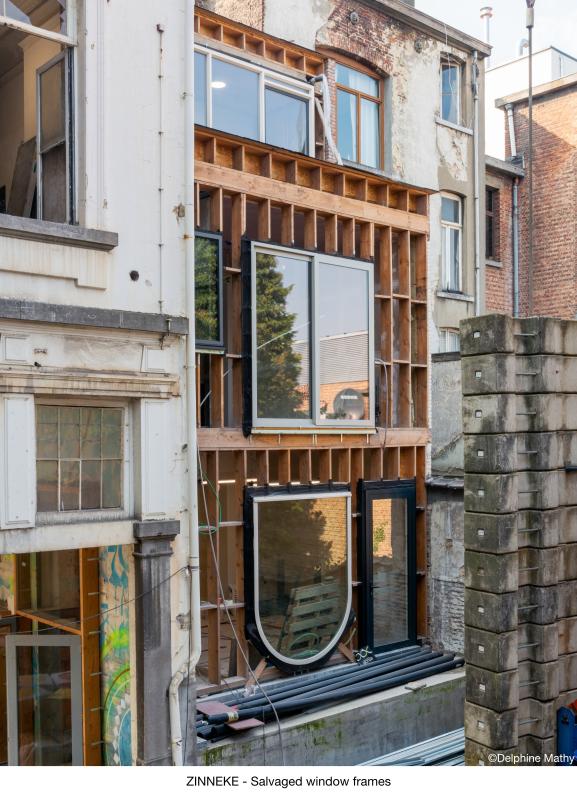


300 to 3.000 m2
Here we enter the realm of larger-scale projects: multi-unit housing complexes, educational and cultural facilities, and so on.
The level of formalism is even higher. This is especially the case in the context of public procurement, where the amounts involved necessitate more stringent procedures.
The volumes of materials required on this scale are also greater. Only a small fraction of companies specializing in the salvage and reuse of materials are able to supply sufficient quantities on the scale of an entire project.
In most cases, it remains possible to approach these projects with reuse confined to certain parts of the project. This may be for specific applications such as interior finishes, lighting or plumbing fixtures, or for limited areas within the project, such as the reception area, common areas, or the surrounding grounds and roadways.
Under these conditions, reuse, while not impossible, requires a certain degree of commitment. One can anticipate a series of obstacles to overcome, which will call for a bit of creativity. However, there is a wealth of experience to draw upon.
3.000 to 30.000 m2
Here we enter the realm of large-scale projects: office buildings, commercial and cultural facilities, small hospitals, and industrial sites.
The level of formalism in procedures becomes even higher. Access to construction sites of this magnitude is generally regulated, requiring specific certifications and compelling references. The chains of contractors are longer and more complex and involve larger teams. For example, architects are generally required to collaborate with experts in structural engineering, acoustics, fire safety, or specialized technical fields. General contractors rely more heavily on subcontracting chains that are more or less long and branched. The project owner must also be more professional or, failing that, seek assistance or be represented by professionals in the field.
The volumes of materials involved become very large.
Today, only a very small fraction of the existing reuse sector is capable of operating on this scale. Administrative and technical requirements, the volumes of materials needed, and the critical importance of meeting deadlines make it extremely difficult for most of the small and medium-sized enterprises (SMEs) that currently make up the reuse sector to participate.
The exception to this are companies that have specialized in a limited range of materials, for which they perform extensive preparation work and maintain large volumes in stock.
To make reuse viable on this scale, it is generally necessary to implement strategies tailored to specific projects, such as establishing reuse loops using materials from the original building (on-site reuse) or undertaking ad hoc sourcing efforts. This requires a determined and proactive approach. One can expect to encounter technical, economic, logistical, organizational, aesthetic, and psychological obstacles, which will require tenacity to overcome.

30.000 to 300.000m2
This is the category of very large-scale projects. Even more so than at the previous scale, we are moving away from the contexts in which reuse flourishes spontaneously.
In this category, the decision to demolish an existing building can have an impact representing up to a few percent of a region’s annual demolition waste production. Even in renovations that preserve a large portion of the existing structure, material flows remain substantial.
Projects of this scale operate in a world tailor-made for standardized industrial materials, characterized by a highly segmented and specialized division of labor.
Only a tiny handful of professional suppliers are capable of working in these contexts. These include, for example, suppliers of office carpet tiles or raised-floor systems, or, on a slightly different note, road works materials.
At this scale, however, the choice of materials can have significant ripple effects. An order for 30,000 m² of exterior cladding or 300,000 m² of raised flooring can make a big difference in a reuse company’s revenue, provided it can fulfill such an order without getting burned in the process! Promoting reuse on this scale also helps prevent the severe environmental damage caused by the production of large quantities of new materials.
Consequently, there is a clear benefit to considering salvage and reuse strategies for these projects. In addition to the on-site reuse approaches already mentioned above, other options include setting up a space for preparing and storing materials or developing ad hoc partnerships with specialized companies. It sometimes even makes sense to convert part of the building into a refurbishment workshop for certain materials. This was done, for instance, during the restoration of the Empire State Building’s windows. In short, it is sometimes possible to take advantage of a certain economy of scale to advance practices across the entire sector.
But make no mistake. At this scale, the problem may be less about increasing reuse than about reducing the scope of these projects.
In fact, the most effective approach remains striving to minimize the material flows required for projects, both the outbound flows resulting from demolition and the inbound flows needed for new construction. This shifts the focus toward strategies for the radical preservation of existing structures. Far more than reuse, which is inevitably limited or even negligible on this scale, these are the most promising strategies for reducing the material and environmental impacts of real estate projects. This principle is, of course, applicable at all scales, but here it takes on striking proportions.
While many cities, including Brussels, (mostly) no longer demolish entire buildings by default, further development is still needed to ensure that architectural elements such as facades, interior finishes, and specialized technical systems, which are generally replaced in their entirety, are also preserved and restored.
Beyond 300.000m2
Here we enter the realm that Rem Koolhaas identifies as “bigness”. We’re talking about very large infrastructure projects: office complexes, convention centers, and major airports.
We’ve seen this coming for a few levels now… Talking about “frugal” construction practices at this scale is an oxymoron. Faced with plans to build such infrastructure from scratch, the only reasonable course of action is to renounce and reject them. It is simply not possible to construct such architecture while respecting planetary boundaries. Salvaging and reusing a few materials won’t make much of a difference.
But what to do about the large scale?
How to deal with the large-scale infrastructure built in the past that is now part of our built environment also remains a question. The range of possibilities is as broad in theory as it remains unexplored in practice. Creative repurposing, various forms of appropriation, the process of becoming a ruin, designating a city’s materials as a “quarry”… All these avenues offer a tremendous scope for exploration and reflection.
However, exploring them will only be possible if we remove these buildings from the realm of real estate development and private ownership, where their status as investments and/or private assets drastically limits their potential futures.
It is highly likely that salvage and reuse practices can play an important role in some of these future scenarios. The experiments currently underway at various scales constitute, at the very least, a potentially fertile learning ground, provided that we draw lessons from them and remain clear-eyed about their limitations. But it is also clear that reuse practices in and of themselves will not bring about such futures. Instead, reuse must be part of a broader approach that rethinks not only our relationship with materials, which is already a colossal undertaking, but also the issues of private property, planning, and power dynamics. Without addressing this broader context, reuse, no matter how much we manage to scale it up, risks being lost in the vastness of the material flows consumed and discarded daily by “business as usual.”