History is a rich reservoir of commendable circular practices in building
"History is a rich reservoir of commendable circular practices in building" (1).
We learnt about a major case of glulam timber reuse, just a stone's throw from the Recypark project, when we attended a presentation made by students of the Studio CUMA from the Faculty of Architecture of the Université libre de Bruxelles.

In 1959, EGTA (Entreprise Générale de Travaux d'Anderlecht) collaborated with architect Edmond Baudewyns to repurpose the entire 'Congo and Ruanda-Urundi' pavilion structure from the 1958 Brussels World's Fair. The original pavilion had been designed by architect Georges Ricquier (2). At that time, barely two years before Congo gained independence, the pavilion still celebrated the colonial model. This included an infamous reconstruction of an 'indigenous village', continuing the vile tradition of human zoos (3).

This is not the only example of reuse from the Brussels World Fair. The 'Urban Planning' pavilion, for example, featured a striking glulam timber structure designed by De Coene and was relocated to their site in Kortrijk after the fair. It remains there to this day and is now the property of the Van Marcke company (4).

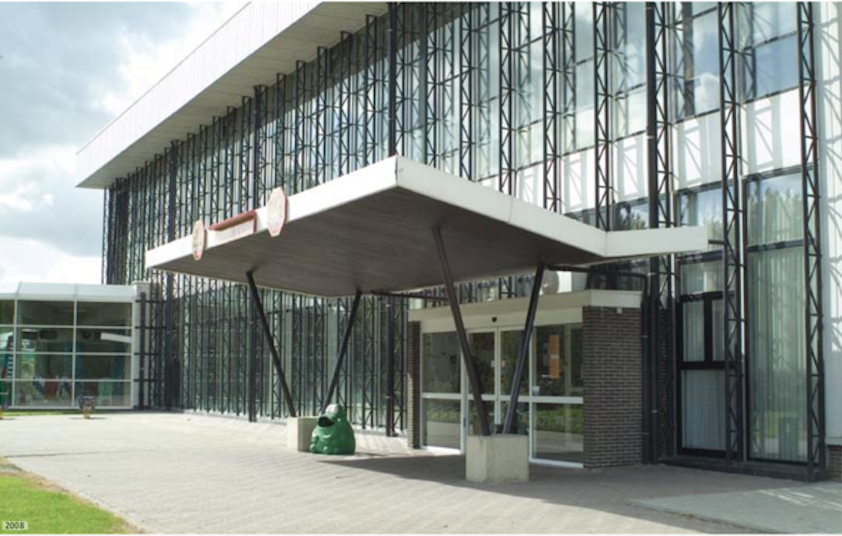
In 2008, a special issue of the journal Acier/Staal investigated fifteen cases of the complete reuse of steel pavilions (5). If you have ever partied at the 'Le Carré' nightclub, visited the 'De Warande' swimming pool in Diest or Wienerberger's showroom in Londerzeel, then you have not only experienced fragments of the 1958 Brussels World Fair, but also striking examples of the reuse of load-bearing materials.
These past examples of reuse demonstrate impressive engineering feats and intriguing examples of sound resource management at a time more often associated with unbridled demolition. The case of the Congo pavilion also raises questions about how cities like Brussels should deal with their colonial pasts (6). To what extent is the racist and imperialist background of that period still embodied in the materials when such a structure is entirely reused and repurposed?


References
(1) Lionel Devlieger, Michaël Ghyoot, Adam Przywara, Karen Steukers, Arne Vande Capelle, and Louise Vanhee, "Circular Design Principles: Between Theory and Practice", Chronograms of Architecture, "https://www.e-flux.com/architecture/chronograms/665748/circular-design-principles-between-theory-and-practice"
(2) Région de Bruxelles-Capitale. Inventaire du patrimoine architectural, "Bureaux et entrepôt de la société EGTA", https://monument.heritage.brussels/fr/buildings/39712
(3) Stanard, M. (2005). "‘Bilan du monde pour un monde plus déshumanisé’: The 1958 Brussels World’s Fair and Belgian Perceptions of the Congo". European History Quarterly, 35(2), 267-298. https://doi.org/10.1177/0265691405051467
(4) SUM Projects + SUM research, Re-use of the Pavilion Expo '58, blog post, 15 Jul 2016, https://www.sum.be/post/2016/07/15/reuse-of-the-pavilion-expo-58
(5) Infosteel, "L'expo 58 et sa seconde vie", Staal_Acier, n° 19. https://www.infosteel.be/fr/notre-magazine/2156-staal-acier-19-l-expo-58-et-sa-seconde-vie
(6) Nicholas Lewis (coll.), Traces et tensions en terrain colonial. Bruxelles et la colonisation belge du Congo. Shed Publishing. 2023. https://shed-publishing.com/Traces-et-tensions-en-terrain-colonial
Images
1. Recypark © Rotor
2. Expo 58, Pavillon du Congo Belge et Ruanda-Urundi
https://monument.heritage.brussels/fr/buildings/39712
3. Warehouse EGTA
https://monument.heritage.brussels/fr/buildings/39712
4. Expo 58, Pavillon de l’Urbanisme
5. Warehouse Van Marcke: © Ann De Gunsch
https://id.erfgoed.net/afbeeldingen/11512